

What is Modified Bituminous Membrane Roofing?

Modified Bituminous Membrane Roofing is essentially a "super-thick, rubber/plastic-infused waterproof tarp" designed for flat or low-slope roofs. Built on an asphalt base modified with high-polymer materials, it is created by blending plastic or putty-like polymers into asphalt and sandwiching a reinforcing layer of thick fabric or fiberglass mesh within. This process transforms it into a "high-strength waterproof sandwich"—a thick, elastic, rubbery sheet that resists tearing, freezing, and sun exposure. Sold rolled up in bolts (hence the term "roll roofing" or membrane), it delivers vastly superior flexibility, heat resistance, and aging resistance compared to standard asphalt.
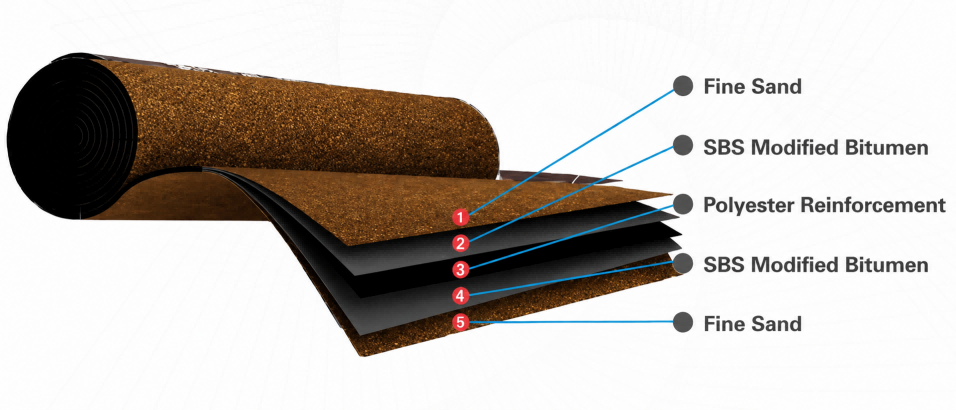
- SBS Modified Bitumen: Modified with synthetic rubber for excellent elasticity and low-temperature flexibility. Ideal for cold climates or areas with large temperature swings.
- APP Modified Bitumen: Modified with plastic polymers for strong heat resistance and UV protection. Ideal for hot, sunny environments.
- Installation Methods: Torch-down (using a heating torch), cold-applied adhesive, or self-adhered (peel-and-stick).
What Are the Core Advantages of Modified Bituminous Membrane Compared to Traditional Unmodified Asphalt?
The word "Modified" brings two key breakthroughs:
- Saying goodbye to the crude "on-site tar boiling" era: In the past, workers had to set up large kettles on roofs to boil black oil—a process that was extremely dirty, foul-smelling, dangerous, and polluting. Transforming it into standardized rolls makes installation far more regulated.
- Making flat-roof buildings truly reliable: Flat roofs used to leak very easily. Thanks to its rubber-like elasticity, modified bitumen solves the fatal pain point of cracking caused by thermal expansion and contraction.
| Comparison Item | Traditional Unmodified Asphalt | Modified Bitumen | Practical Benefits / Value |
| Temperature Adaptability | Soft as mud in summer, brittle as a cracker in winter | Does not crack at -20°C, does not melt or run above 100°C | Will not crack or leak whether exposed to scorching sun or freezing weather year-round. |
| Flexibility & Stretchability | Zero elasticity; snaps when pulled | Excellent rubber-like elasticity | The waterproofing layer stretches with the building as it expands, contracts, or settles slightly without breaking. |
| Installation Difficulty | Requires boiling asphalt in large kettles on-site; emits black smoke and is extremely dangerous | Factory-formed prefabricated rolls; directly torched or cold-applied on-site | Installation speed is several times faster; quality is controlled at the factory, preventing uneven thickness. |
| Service Life | 5 – 10 years (highly prone to cracking and leaking) | 15 – 30 years | Avoids the hassle and high labor costs of having to repair the roof every few years. |
How Does Modified Bituminous Membrane Waterproof? (Working Principle)
Its waterproofing principle is simple and straightforward, relying on three main points:
- Relying on "Thickness" to resist water: Regular waterproof paints might be only a thin layer (less than 1 mm), but a single sheet of this membrane is 3 to 4 mm thick. A two-ply setup reaches nearly 1 cm thick, making it completely impenetrable to water.
- Relying on "Torching into a single sheet": During installation, workers use a torch to melt the asphalt on the underside of the roll and stick it to the roof like glue while hot. Where two rolls overlap, torching fuses them together, turning the entire roof into one seamless, continuous sheet.
- Built-in "Self-Healing": Because it contains rubberized asphalt, if a small nail punctures a hole, higher summer temperatures will soften the asphalt, allowing it to automatically flow, fill, and seal the puncture.
What Are the Pros and Cons of Modified Bituminous Membrane?
Pros
- Super Tough: It is very difficult to puncture, even with people stepping on it, moving equipment over it, or fallen small branches hitting it.
- Extremely Durable: A two-ply system easily lasts over 20 years.
- Super Easy to Repair: If a tear occurs, simply cut a small patch of new membrane, heat it with a torch, and stick it over the hole for an instant fix.
Cons & Limitations (When It Cannot Be Used):
- Fire Danger Risk: Installation involves using a torch with an open flame. If there are flammable materials nearby like wood or insulation boards, it can easily cause a fire hazard.
- Strong Odor & Industrial Appearance: Freshly installed roofs emit a strong burnt asphalt smell, and the dark surface (or surface covered with gravel) is suitable only for roofs, not indoor living room floors.
- Too Heavy: Combining several rolls is very heavy, which old, dilapidated houses or weak wooden roof structures may not support.
- High Workmanship Requirement: If a single small seam is not torch-bonded properly, water can seep along the gap and spread under the entire roof.
How Long Does Modified Bituminous Membrane Last? (Service Life)
Generally speaking, the practical service life of a modified bitumen membrane roof is about 15 to 25 years. Systems with high installation quality, proper drainage design, and timely maintenance can typically last 25 to 30 years or longer. Some certified high-quality systems have an expected service life exceeding 35 years.
| System Configuration / Factor | Expected Lifespan | Description |
| Single-Ply System | 10 – 15 Years | Lower cost, relatively weaker puncture resistance. |
| 2-Ply / Multi-Ply System | 20 – 30 Years | Base layer + cap sheet dual protection; significantly improved durability. |
| Well-Maintained System | 25+ Years | Regular drain cleaning, timely leak patching, and applying reflective sun-protection coatings can extend lifespan. |
Major Factors Affecting Lifespan:
- Number of Installed Layers: Dual-ply (2-Ply) installation is far more durable than single-ply and is currently the preferred option for commercial and residential flat roofs.
- Installation Quality: The quality of heat-welding or adhesive bonding at edge seams directly determines leak resistance.
- Drainage Conditions: If standing water remains on the roof long-term, the aging rate of the asphalt layer will accelerate.
- Surface Coatings: Light-colored mineral granules or aluminum reflective sun-protection coatings on the surface can significantly reduce UV damage.
What Environments Is Modified Bituminous Membrane Suited For, and What Should You Watch Out For?
- Where It Is Suited: Commercial building roofs, flat residential roofs, patios, basement damp-proofing, and carports. It offers the best value for any flat or low-slope roof.
- Where It Is NOT Suited: Steep-pitched tile roofs (cannot lay flat) or wooden roofs (fire hazard from torching).
Critical Precautions: Never install on rainy days or wet roofs: Trapped moisture beneath the membrane will expand into large blisters under the sun, causing instant waterproofing failure. The roof must have a drainage slope: Do not let the roof turn into a pond; long-term standing water will shorten the lifespan of even the best waterproofing layer.