

Swimming Pool Waterproofing Membrane vs. Coating: How to Choose the Right Solution

Swimming Pool Waterproofing Membrane vs. Coating: How to Choose the Right Solution
A waterproofing system for a swimming pool is one that must withstand constant exposure to water while at the same time ensuring that the structure below is protected against leaks and water damage. There could be an added requirement for dealing with movement of concrete, hydrostatic pressures, chemicals, etc.
Two common approaches are waterproofing membranes and liquid-applied waterproofing coatings. While both can provide a waterproof barrier, they differ in application, detailing, and suitability for different project conditions.

What Should Swimming Pool Waterproofing Withstand?
The right waterproofing system should be selected according to the conditions the pool will face during construction and long-term use.
Continuous Water Exposure
Unlike most building areas that are only occasionally exposed to moisture, swimming pools remain in contact with water for long periods. Therefore, waterproof materials need to maintain their integrity even when continuously exposed to moisture.
Hydrostatic Pressure and Structural Movement
Water pressure can place a continuous load on the waterproofing system. At the same time, concrete may experience shrinkage, temperature-related movement, or minor cracking.
A suitable system should have the flexibility and adhesion required for the expected level of movement.
Chemicals and Vulnerable Details
Pool water may contain chlorine and other treatment chemicals. Material compatibility should therefore be considered alongside water resistance.
Details also deserve particular attention. Construction joints, corners, drains, pipe penetrations, and changes in plane can become potential leakage points if they are not properly treated.
Swimming Pool Waterproofing Membrane
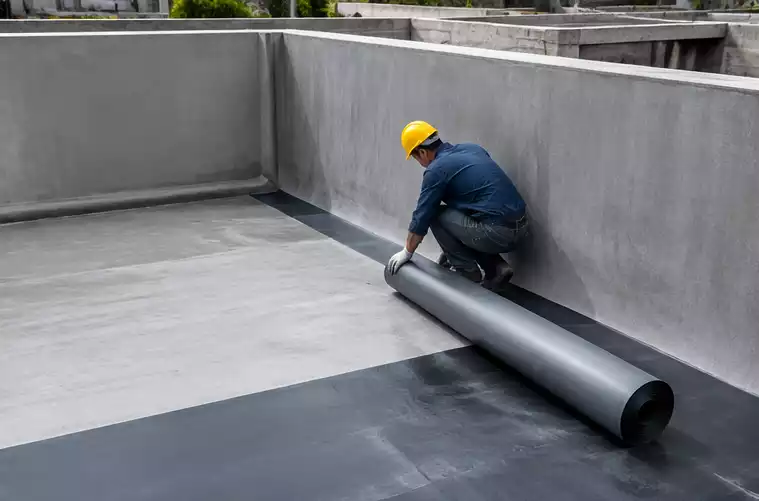
The waterproofing membrane acts as a physical layer over or within the pool construction. Depending on the product and installation system, it may be supplied as a sheet membrane or incorporated into a bonded waterproofing assembly.
Defined Thickness and Physical Barrier
One advantage of a membrane system is that the material is manufactured with a defined thickness. This provides a consistent physical layer when the membrane is correctly installed.
Membranes can be suitable for larger, clearly defined surfaces where a continuous waterproofing barrier is required.
Seam and Detail Treatment
The main membrane surface is only part of the system. Sheet membranes require careful treatment at:
- Seams and overlaps
- Internal and external corners
- Pipe penetrations
- Drains and outlets
- Construction and movement joints
- Terminations
Installation quality is therefore critical to the overall waterproofing performance.
When a Membrane May Be Suitable
A membrane can be considered when the project requires a durable physical barrier and the surface geometry allows the membrane to be properly installed and detailed.
The specific membrane type should still be selected according to water exposure, chemical conditions, substrate compatibility, and expected movement.
Swimming Pool Waterproofing Coating
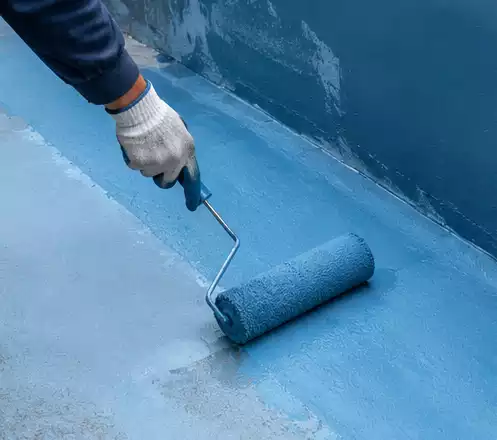
A waterproofing coating is applied in liquid form and cures to create a continuous waterproofing layer on the substrate.
Continuous Coverage
Because the coating is applied directly to the surface, it can form a continuous layer without the sheet seams associated with traditional membrane installation.
This can be useful around certain corners, transitions, and irregular areas where maintaining continuous coverage is important.
Application Depends on the Substrate
The performance of a coating depends heavily on the condition of the substrate and the application process.
Before application, the surface may need to be:
- Clean and free from contaminants
- Properly repaired
- Sufficiently stable
- Prepared according to the product requirements
- Within the specified moisture conditions
Application thickness and curing conditions should also be controlled according to the manufacturer's technical requirements.
When a Coating May Be Suitable
A coating may be considered when the project benefits from a liquid-applied system, particularly where complex surface geometry or detailed coverage is a concern.
However, different coatings have different levels of flexibility, chemical resistance, adhesion, and water resistance. Product selection should therefore be based on the actual pool environment rather than the word "coating" alone.
Membrane vs. Coating for Swimming Pools
The choice is not simply a matter of deciding which material is stronger. The installation environment, substrate, project geometry, and long-term exposure all need to be considered.
| Factor | Waterproofing Membrane | Waterproofing Coating |
| Application | Sheet or system-based installation | Liquid-applied |
| Surface coverage | Well suited to defined surfaces | Can conform to irregular surfaces |
| Seams | Requires dedicated seam treatment | No sheet seams |
| Thickness | Generally predefined | Controlled during application |
| Complex details | Requires careful cutting and detailing | Can be easier to apply around some details |
| Substrate preparation | Important for bonding and installation | Critical for adhesion and coating performance |
| Repair | Depends on the membrane system | Some systems allow local recoating |
The table provides a general comparison. Actual performance depends on the specific product, installation method, and project conditions.
How to Choose the Right Waterproofing System
Rather than choosing a product based on one feature, evaluate the entire waterproofing system against the project requirements.
1. Check the Pool Structure
Think about whether the pool is a newly built concrete structure, a structure that already exists but needs to be renovated, or a structure that has an odd geometry. The shape and construction method of the swimming pool will affect the practicality of different waterproofing systems.
2. Evaluate the Substrate
Inspect the surface for any cracks, imperfections, construction joints, moisture, and contaminants. Both membranes and coatings need proper substrate preparation, even though the requirements may vary.
3. Consider Water and Chemical Exposure
The material should be suitable for continuous water contact and compatible with the chemicals used during normal pool operation.
4. Plan for Details
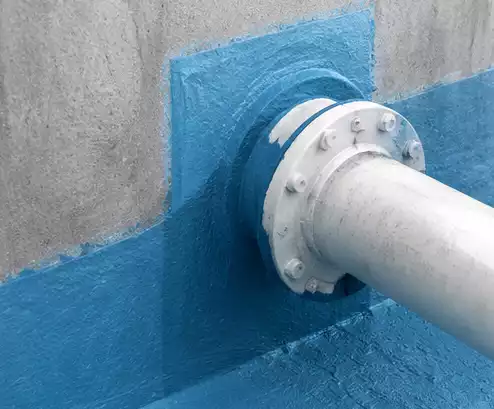
Do not evaluate only the main pool surface. Drains, corners, pipe penetrations, joints, and transitions should be included when designing the waterproofing system.
5. Review Technical Data
Before selecting a product, check its technical data for properties such as:
- Water resistance
- Tensile strength and elongation
- Crack-bridging capability
- Chemical resistance
- Temperature resistance
- Adhesion
- Recommended application conditions
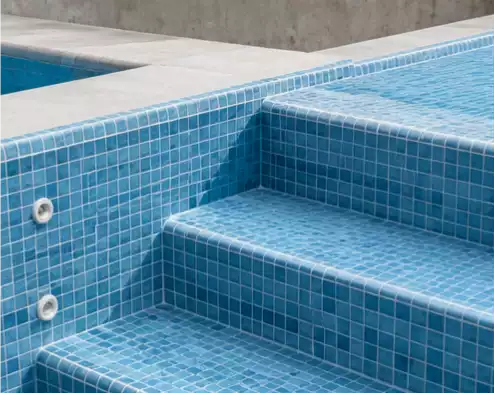
This means that the best waterproofing for a swimming pool may not be a particular type of material. It will be the type of waterproofing that fits the building and the conditions where it will be applied.
In the process of selecting membranes or coatings, looking at the technical data provided by the manufacturer and understanding the application requirements prior to construction will minimize installation issues.