

What is SBS Waterproofing Membrane?

What is SBS? Simply put, it is "asphalt with added rubber." Ordinary asphalt (the kind used for paving roads) melts and becomes sticky easily in summer, and freezes hard as a cracker in winter, snapping upon bending. SBS involves blending synthetic rubber into the asphalt. With this modification, the asphalt instantly becomes like a rubber band: stretchable, elastic, and cold-resistant.
This means that in cold environments, regions with large temperature variations, or projects prone to structural deformation and vibration, SBS is far more reliable than ordinary asphalt or rigid waterproofing systems. However, in poorly ventilated spaces, open-flame restricted areas, or on damp substrates, self-adhesive SBS membranes or other cold-applied systems should be preferred.
Slice the membrane open with a knife, and it resembles a 5-layer sandwich biscuit (typical torch-applied SBS membrane):
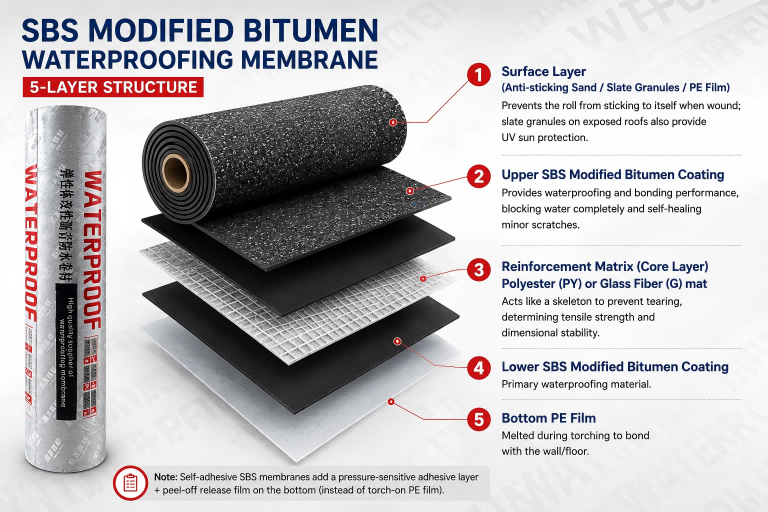
- Surface Layer (Anti-sticking Sand / Slate Granules / PE Film): Prevents the roll from sticking to itself when wound; slate granules on exposed roofs also provide UV sun protection.
- Upper SBS Modified Bitumen Coating: Provides waterproofing and bonding performance, blocking water completely and self-healing minor scratches.
- Reinforcement Matrix (Core Layer): Polyester (PY) or Glass Fiber (G) mat (the non-woven "skeleton" in the middle). Acts like a human skeleton to prevent tearing, determining tensile strength and dimensional stability.
- Lower SBS Modified Bitumen Coating: Primary waterproofing material.
- Bottom PE Film: Melted during torching to bond with the wall/floor. (Note: Self-adhesive SBS membranes add a pressure-sensitive adhesive layer + peel-off release film on the bottom surface to enable cold application without an open flame).
4 Main Categories of SBS Membranes:
- By Reinforcement (Core Matrix): Polyester mat (PY: high tensile strength, anti-settlement, preferred choice), Glass fiber mat (G: dimensionally stable, non-elastic), Composite mat.
- By Surface Facing: PE film (PE: for unexposed/concealed use), Slate granules/Mineral chips (M: for UV-protected exposed use), Fine sand (S).
- By Performance Grade: Type I (-20°C low-temperature flexibility, for standard projects), Type II (-25°C low-temperature flexibility, for high-standard/northern projects).
- By Application Method: Torch-applied (open flame heating), Self-adhesive (peel-and-stick). Self-adhesive SBS membranes feature a pressure-sensitive adhesive layer + release film on the bottom surface, enabling cold application (no open flame).
Working Principle
SBS waterproofing membranes ensure long-lasting waterproofing through a triple action mechanism:
- Physical Water Barrier: The modified bitumen coating creates a continuous, dense water barrier that water molecules cannot penetrate.
- Stress Absorption & Movement Tracking: When buildings undergo slight displacements or micro-cracks due to thermal expansion/contraction or foundation settlement, the internal elastomer stretches freely and absorbs tensile stress, ensuring the waterproofing layer does not rupture.
- Self-Healing Seal: Upon encountering minor punctures or needle pressings, the compound exhibits micro-fluidity under pressure, automatically sealing gaps to prevent localized leaks.
Pros, Cons & Limitations
1) Advantages & Performance
- No Cracking at -20°C to -25°C: Low-temperature flexibility allows bending down to -20°C to -25°C without cracking, making it ideal for severe winter construction and use in northern climates.
- High Elasticity & Elongation: Elongation at break reaches 30%–50% or more, featuring excellent elastic recovery capability.
- Puncture & Fatigue Resistance: Combined with a polyester/glass fiber matrix, it withstands mechanical wear and foot traffic during construction.
- Long Lifespan (20–30 Years): Under standard production and installation, the waterproofing lifespan can reach 20–30+ years.
2) Disadvantages & Limitations
- Slightly Limited High-Temperature Resistance: Heat resistance is generally around 90°C–105°C; under prolonged, extreme high-temperature sun exposure, it is inferior to APP modified bitumen.
- Fire Risk During Installation: Traditional torching requires propane torch heating, which produces smoke and limits its use in fire-prohibited areas like gas stations and grain depots.
- High Substrate Requirements: The substrate must be flat, clean, and dry, and detail processing heavily relies on worker skill.
Main Applications & Reasons
- Flat & Sloped Roofs: Exposed directly to sun, wind, and thermal expansion/contraction, relying on SBS's high elongation and weather resistance to absorb deformations.
- Basement Slabs & Exterior Walls: Year-round exposure to hydrostatic groundwater pressure and foundation settlement; polyester-based SBS provides superior impermeability and tensile elongation capability
- Bridges, Tunnels & Parking Decks: Frequently subjected to traffic vibrations and shear loads, where SBS offers significant fatigue-resistance advantages.
Procurement Notes & Recommendations
- Ensure Standard Thickness: Specifications typically require single-layer thickness to be 3mm or 4mm. If too thin, it is easily burned through by the torch during installation, causing failure.
- Choose the Right Grade (Don't Cut Corners): For northern regions and high-standard projects, always select PY Type II (pure polyester mat + flexibility down to -25°C).
- Identify Fake Polyester Mats: Tear the edge to inspect: pure polyester mat fibers show strong, tough tensile resistance, whereas inferior composite mats reveal sparse grid lines that tear easily.
- Select Self-Adhesive for Fire-Prohibited Sites: In gas stations, warehouses, and enclosed spaces, open-flame torching is strictly forbidden—procure self-adhesive SBS membranes directly.